


Choosing the wrong valve causes leaks and shuts down your line. You lose money replacing parts while production stops. Read this guide to specify the exact valve your system needs.
The “pieces” refer to the body of valve structure. A 1 piece ball valve is solid. A two piece ball valve splits once. A three piece ball valve splits twice.
This structure limits your maintenance options. Let us look at the real-world differences to help you choose wisely.
Key Difference 1: Maintenance & Repair
The way a valve is built determines how much time your team spends fixing it.
- 1-Piece: Non-Repairable (Throwaway)
The 1 piece ball valve is a single solid block. You cannot open it. If the internal seal fails, you must throw the whole valve away. It is a “disposable” part. Use this unibody ball valve only for low-risk water or air lines where you never expect to clean the inside. - 2-Piece: Requires Line Shutdown
To fix a two piece ball valve, you must shut off the entire pipeline. You have to unthread or unbolt the 2 piece ball valves and remove them completely from the pipes. You cannot repair a 2 piece ss ball valve while it is still attached. - 3-Piece: In-Line Repairable
The ball valve 3 piece body has a center section that “swings out.” You leave the ends attached to the pipe and only remove the middle. This makes 3 piece ball valves the best choice for welded pipes. You can change seals in minutes without cutting any metal.

Key Difference 2: Port Size and Flow Capacity
Flow capacity affects how hard your pumps have to work.
- Reduced Port (1-Piece Valves): A 1pc ball valve usually has a hole smaller than the pipe. This chokes your flow and causes a pressure drop. It is cheap but inefficient for high-volume systems.
- Full Port (2 & 3-Piece Valves): A 3-piece ball valve usually has a hole the exact same size as your pipe. Fluid runs straight through. A stainless steel ball valve 3/4 in this style offers zero resistance.
- System Impact: Using a manual ball valves with a reduced port acts like a bottleneck. This forces pumps to work harder, increasing your energy costs.
Key Difference 3: Costs (Upfront vs. Long-Term)
Don’t just look at the price tag on day one. Consider the Total Cost of Ownership (TCO).
| Valve Type | Upfront Cost | Maintenance Cost | Replacement Difficulty |
| 1-Piece | Lowest | High (Must buy new) | Hard (Remove whole valve) |
| 2-Piece | Moderate | Medium (Labor cost) | Medium (Remove whole valve) |
| 3-Piece | Highest | Lowest (Cheap seals) | Easy (Fix while in-line) |
Note: If you ask how much does it cost to replace a ball valve, the answer for a 3-piece is usually just the cost of a small seal kit and 10 minutes of labor.
Key Difference 4: Pressure and Safety
- 1-Piece Strength: The one piece ball valve has no body joints, so it won’t leak from the middle. However, it cannot handle extreme industrial pressures.
- High-Pressure Excel: 3 piece ball valves use thick metal walls and heavy bolts. This lets them hold tough parts like metal to metal seated ball valves.
- Safety: For high-pressure steam or a ball valve pressure washer system, you need the heavy-duty bolts of a multi-piece ball valve design.

Comparison Summary Table
| Feature | 1-Piece Ball Valve | 2-Piece Ball Valve | 3-Piece Ball Valve |
| Design | Solid Body | 2 Body Parts | 3 Body Parts |
| Hole Size | Reduced Port | Full Port | Full Port |
| Repair | Replace Whole Valve | Remove from Pipe | Fix In-Line |
| Best For | Cheap, simple lines | General Factory Use | Critical/Welded Lines |
Application Guide: Which Valve Should You Pick?
Use 1-Piece Ball Valves if:
- You are on a very tight initial budget.
- The system handles clean water or air.
- You don’t care about flow restriction.
- Example: A simple 1/4 inch ball valve for a basic drain.

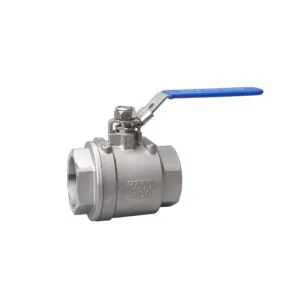
Use 2-Piece Ball Valves if:
- You need a standard factory workhorse for oil or gas.
- You want a full port but don’t want to pay 3-piece prices.
- You are replacing an old 1/2 globe valve and want better flow.
- Your pipes are threaded, not welded.
Use 3-Piece Ball Valves if:
- Your pipes are welded (you can’t remove the valve easily).
- The valve opens/closes many times a day (high-cycle).
- You are in the food or medicine industry and need to clean the inside.
- You want the lowest possible maintenance cost over 10 years.

Knowing the limits of one, two, and three-piece ball valves saves you from buying the wrong parts twice. At Hearken Flow, we use our 16 years of factory-direct experience to build valves that do not fail under pressure. We hold a massive stock of standard sizes to keep your projects on schedule.
Would you like me to connect you with our engineering team to review your pipeline drawing and recommend the exact valve you need?
Frequently Asked Questions
As a valve engineer, I hear these questions all the time on the factory floor. Here are the straight answers you need for your procurement decisions.
Q: Can I weld a 1-piece or 2-piece valve directly into my line?
A: I wouldn’t recommend it. If you weld a 1 piece ball valve or a two piece ball valve, the heat will likely destroy the soft seats inside. Since you can’t take these valves apart easily, you’re stuck with a leaky valve you can’t fix. Always go with a 3-piece ball valve for welding; you can pull the middle section out and keep the seals safe from the heat.
Q: Is “Standard Port” the same as “Full Port”?
A: No, and don’t let a salesperson tell you otherwise. A “Standard Port” (usually found on a 1pc ball valve) has a smaller hole than your pipe. If you need 100% flow capacity, you must specify a “Full Port” 2 piece ball valve or 3-piece model.
Q: Why is the 3-piece valve so much more expensive?
A: You’re paying for the extra machining and the bolts. A ball valve 3 piece body requires three separate castings and precision alignment. It costs more on day one, but when you realize how much does it cost to replace a ball valve (labor, downtime, and new parts), the 3-piece pays for itself the first time you service it.
Q: Which one handles high pressure the best?
A: Generally, the 2 piece ball valve and 3-piece models excel here. Because they have more “meat” on the body of valve and use heavy-duty bolting, they can support high-pressure seals like metal to metal seated ball valves. A basic unibody ball valve is usually meant for lighter, commercial-grade pressure.


