Incorrect valve connection types cause severe leaks and catastrophic pipeline failures. You must select proper valve end connection types for system safety. This engineering guide provides exact technical solutions.
Valve end connection types determine how valves join pipelines. Main industrial methods include flanged, threaded, welded, and wafer designs, each engineered for specific pressure ratings and precise flow control requirements.
Master these types of piping connections below to ensure zero-leakage integrity, optimize automation fail-safes, and meet strict industrial standards.
Why Valve Connection Types Matter
When you design industrial flow systems, understanding valve connection types is mandatory. These mechanical joints determine the structural integrity of your piping network. Incorrect pipe fittings and valves lead to critical system failures. A proper joint connection valve selection directly impacts:
- System Safety: Preventing blowouts under high pressure.
- Automation Reliability: Ensuring precise torque transfer from actuators.
- Regulatory Compliance: Meeting ATEX (explosive atmospheres) and SIL3 standards.
Overview of Valve End Connection Types
Types of Valve End Connections Matrix
You will encounter several main valve end connection types in heavy industrial environments. The exact valve pipe fitting methodology dictates your maintenance capabilities.
| Connection Type | Pressure Rating | Key Application | Maintenance & Removal |
| Flanged | ASME Class 150-2500 DIN PN10-PN400 | Heavy industry, large bore piping | High ease (Bolt removal) |
| Threaded | Low to Medium | Fluid instrumentation | Medium ease |
| Welded | Extreme High Pressure | Hazardous media, zero-leakage | Low ease (Requires cutting) |
| Wafer/Lug | Medium to High | Automated valves, compact spaces | High ease |
(Note: Specialized instrumentation may use a compression fitting definition, describing a mechanical device utilizing a compressed ferrule for sealing).
Valve Connection Types by Industrial Application
Ball Valve Connection Types
When evaluating ball valve connection types, match the connection to the system scale:
- Heavy Duty (Flange valves): Flanged connection styles (RF, FF, RTJ) accommodate ASME and DIN high-pressure ratings. They provide superior structural strength.
- Small Bore (Threaded valve connections): In threaded vs flanged comparisons, threaded allows rapid assembly. For chemical water treatment, a 1/2 PVC ball valve threaded unit is standard.
- Thread Terminology: You must understand FNPT meaning (Female National Pipe Thread). If asked, “What is FNPT in plumbing?”, it refers strictly to internal female threads. Knowing FNPT vs MNPT ensures correct screwed pipework assembly.
Butterfly Valve End Connection Types
Wafer Type Butterfly Valve Connection
The wafer type butterfly valve connection provides exceptional mechanical reliability in compact spaces.
- Installation: Clamped securely between two pipe flanges.
- Advantage: Minimizes face-to-face dimension and reduces system weight.
- Requirement: Exact flange bolt tensioning for even load distribution.
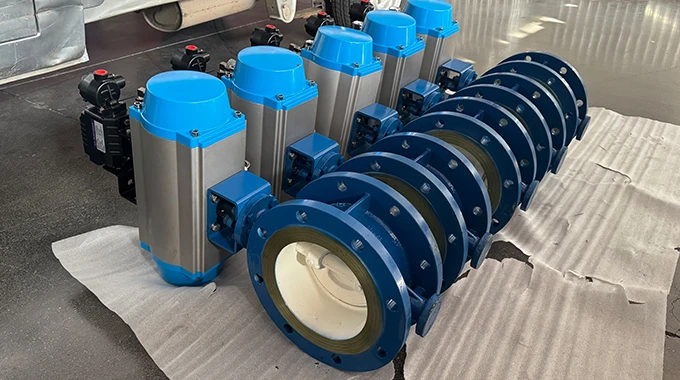
Field Application Data: Hearken Flow recently delivered 80 automated wafer butterfly valves to a Mexican industrial plant. The compact wafer type valve connection allowed seamless installation in constrained layouts.

Lug Type Connection
Another primary butterfly valve end connection types is the lug design.
- Design: Features threaded inserts integrated directly on the valve body.
- Advantage (Dead-end Service): Allows you to bolt directly to each pipe flange independently. You can remove downstream piping while maintaining upstream pressure.
- Specification: When analyzing industrial valves and fittings use-cases, calculate maximum pressure differentials to choose between wafer and lug.

Gate Valve Connections: Flanged vs Welded
Your selection of gate valve connection types depends on the isolation requirement:
- Flanged connections types: Standard choice for straightforward maintenance and rapid replacement.
- Welded Connections (Socket/Butt Weld): Mandatory for extreme temperatures and strict zero-leakage tolerances. They fuse metal directly to the pipeline, offering maximum structural integrity.

Gas, Chemical & Specialized Connections
- Quick connect fittings with built-in valves: Used for rapid line joining. The internal poppet (often called a hose end valve) instantly closes upon decoupling to prevent hazardous chemical release.
- Valve gas cylinder connection types: Utilize specific left-hand or right-hand threads to physically prevent accidental cross-connection of incompatible gases.
- Agricultural/Industrial: Heavy-duty types of irrigation valves and piping valves types frequently utilize secure flanged or specialized quick-connects for high-volume fluid routing.
Actuation and Testing Standards
ISO 5211 Actuator Integration
Heavy-duty flanged and wafer valves must interface with actuators meeting the ISO 5211 standard:
- Dictates exact mounting flange dimensions and drive shaft geometry.
- Minimizes mechanical hysteresis and torque loss.
- Guarantees precise, repeatable torque transmission directly to the valve stem when using Hearken Flow’s aluminum alloy pneumatic actuators.
API 598 Pressure Testing Protocols
Connection methods strictly dictate your API 598 testing execution:
- Flanged Connections: Requires specific blind flange fixtures and calibrated bolting during the hydrostatic shell test.
- Welded Connections: Demands highly specialized test rigs to seal open ends without damaging weld bevels, paired with rigorous non-destructive testing (NDT).
Conclusion
Summary & Resources
Your structural connection choice dictates pipeline integrity, automated fail-safe reliability, and API 598 testing procedures. Proper specification ensures ATEX and SIL3 compliance. Consult a comprehensive pipe fitter valve guide or request a complete Valve End Connection Types PDF containing dimensional data and torque calculations for your internal engineering database.
Hearken Flow: Your Source OEM Valve Manufacturer
For customized, high-performance mechanical flow control solutions, partner with Hearken Flow. We represent true source manufacturing located in Wenzhou, China—the world’s core industrial valve cluster.
- Production Capacity: Over 70,000 units monthly (pneumatic actuators/electric actuators and valves).
- Delivery Speed: Strict standard production lead time of 15 to 25 days.
- Quality Control: Rigorous testing in our in-house laboratory.
- Global Logistics: Robust wooden case packaging ensures absolute physical security for international transits.
Action: Contact the Hearken Flow technical support team today to receive precise torque calculations and engineer a bespoke OEM/ODM valve connection solution for your facility.